کمک های کامپیوتری
تاریخ : دوشنبه 11 مهر 1390
نویسنده : konami

AK-47

From Wikipedia, the free encyclopedia
 
Jump to: navigation, search
AK-47[1]
Rifle AK-47.jpg
Standard AK-47
Type Assault rifle
Place of origin  Soviet Union
Service history
In service 1949–present
Used by See Users
Production history
Designer Mikhail Kalashnikov
Designed 1944–1947
Manufacturer Izhmash
Number built approximately 75 million AK-47
100 million AK-type rifles[2][3]
Variants See Variants
Specifications
Weight 5.21 kg (11.5 lb) with empty magazine
Length 870 mm (34 in) fixed wooden stock
875 mm (34.4 in) folding stock extended
645 mm (25.4 in) stock folded
Barrel length 415 mm (16.3 in)

Cartridge 7.62×39mm M43/M67
Action Gas-operated, rotating bolt
Rate of fire 600 rounds/min
Muzzle velocity 715 m/s (2,346 ft/s)
Effective range 400 metres (440 yd) semi-automatic[4]

300 metres (330 yd) full automatic[4]

Feed system 10, 20 , 30 , 40 or 75 -round detachable box and drum style magazine, also compatible with 40-round box or 75-round drum magazines from the RPK
Sights Adjustable iron sights, 100–800 metre adjustments, 378 mm (14.9 in) sight radius

The AK-47 is a selective-fire, gas-operated 7.62×39mm assault rifle, first developed in the Soviet Union by Mikhail Kalashnikov. It is officially known as Avtomat Kalashnikova (Автомат Калашникова). It is also known as a Kalashnikov, an "AK", or in Russian slang, Kalash.

Design work on the AK-47 began in the last year of World War II (1945). After the war in 1946, the AK-46 was presented for official military trials. In 1947 the fixed-stock version was introduced into service with select units of the Soviet Army. An early development of the design was the AKS (S—Skladnoy or "folding"), which was equipped with an underfolding metal shoulder stock. In 1949, the AK-47 was officially accepted by the Soviet Armed Forces and used by the majority of the member states of the Warsaw Pact.

The original AK-47 was one of the first true "assault rifles" to be manufactured, after the original Sturmgewehr 44.[5][6] Even after six decades the model and its variants remain the most widely used and popular assault rifles in the world because of their durability, low production cost, and ease of use. It has been manufactured in many countries and has seen service with armed forces as well as revolutionary and terrorist organizations worldwide. The AK-47 was the basis for developing many other types of individual and crew-served firearms. More AK-type rifles have been produced than all other assault rifles combined.[2]

Firing the 7.62x39mm cartridge, the AK-47 produces significant wounding effects when the projectile tumbles and fragments in tissue;[7] but it produces relatively minor wounds when the projectile exits the body before beginning to yaw.[8][9]

Contents

[hide]

History

Design background

During World War II, the Germans first pioneered the assault rifle concept, based upon research that showed that most firefights happen at close range, within approximately 300 meters.[citation needed] The power and range of contemporary rifle cartridges was excessive for most small arms firefights. As a result, armies sought a cartridge and rifle combining submachine gun features (large-capacity magazine, selective-fire) with an intermediate-power cartridge effective to 300 meters. To reduce manufacturing costs, the 7.92x57mm Mauser cartridge case was shortened, the result of which was the lighter 7.92x33mm Kurz.

The resultant rifle was the Sturmgewehr 44 (StG44). An earlier firearm, the Italian Cei-Rigotti combined similar features but suffered poor reliability and ejection mechanism, as well as inferior magazine capacity. Towards the end of the war, the Germans fielded the StG44 against the Soviets; the experience deeply influenced Soviet military doctrine in the post-war years.[citation needed]

Mikhail Kalashnikov began his career as a weapon designer while in a hospital after he was shot in the shoulder during the Battle of Bryansk.[10] After tinkering with a sub-machine gun design, he entered a competition for a new weapon that would chamber the 7.62x41mm cartridge developed by Elisarov and Semin in 1943 (the 7.62x41mm cartridge predated the current 7.62x39mm M1943). A particular requirement of the competition was the reliability of the firearm in the muddy, wet, and frozen conditions of the Soviet front line. Kalashnikov designed a carbine, strongly influenced by the American M1 Garand, that lost out to the Simonov design that later became the SKS semi-automatic carbine. At the same time, the Soviet Army was interested in developing a true assault rifle employing a shortened M1943 round. The first such weapon was presented by Sudayev in 1944, but trials found it to be too heavy.[11] A new design competition was held two years later where Kalashnikov and his design team submitted an entry. It was a gas-operated rifle which had a breech-block mechanism similar to his 1944 carbine, and a curved 30-round magazine.

Kalashnikov's rifles (codenamed AK-1 and −2) proved to be reliable and the weapon was accepted to second round of competition along with designs by A.A Demetev and F. Bulkin. In late 1946, as the rifles were being tested, one of Kalashnikov's assistants, Aleksandr Zaytsev, suggested a major redesign of AK-1, particularly to improve reliability. At first, Kalashnikov was reluctant, given that their rifle had already fared better than its competitors. Eventually, however, Zaytsev managed to persuade Kalashnikov. The new rifle was produced for a second round of firing tests and field trials. There, Kalashnikov assault rifle model 1947 proved to be simple and reliable under a wide range of conditions with convenient handling characteristics. In 1949 it was therefore adopted by the Soviet Army as '7.62mm Kalashnikov assault rifle (AK)'.[12]

Design concept

The AK-47 is best described as a hybrid of previous rifle technology innovations: the trigger, double locking lugs and unlocking raceway of the M1 Garand/M1 carbine,[13] the safety mechanism of the John Browning designed Remington Model 8 rifle,[14] and the gas system and layout of the Sturmgewehr 44. Kalashnikov's team had access to all of these weapons and had no need to "reinvent the wheel",[15][16] though he denied that his design was based on the German Sturmgewehr 44 assault rifle.[17] Kalashnikov himself observed: "A lot of [Soviet Army soldiers] ask me how one can become a constructor, and how new weaponry is designed. These are very difficult questions. Each designer seems to have his own paths, his own successes and failures. But one thing is clear: before attempting to create something new, it is vital to have a good appreciation of everything that already exists in this field. I myself have had many experiences confirming this to be so."[18]

Receiver development

AKMS on a Type 4B receiver (top), with a Type 2A
A Type 2 AK-47, the first machined receiver variation

There were many difficulties during the initial phase of production. The first production models had stamped sheet metal receivers. Difficulties were encountered in welding the guide and ejector rails, causing high rejection rates.[19] Instead of halting production, a heavy machined receiver was substituted for the sheet metal receiver.[20] This was a more costly process, but the use of machined receivers accelerated production as tooling and labor for the earlier Mosin-Nagant rifle's machined receiver were easily adapted. Partly because of these problems, the Soviets were not able to distribute large numbers of the new rifle to soldiers until 1956. During this time, production of the interim SKS rifle continued.[20]

Once manufacturing difficulties had been overcome, a redesigned version designated the AKM (M for "modernized" or "upgraded"—in Russian: (Автомат Калашникова Модернизированный [Avtomat Kalashnikova Modernizirovanniy]) was introduced in 1959.[21] This new model used a stamped sheet metal receiver and featured a slanted muzzle brake on the end of the barrel to compensate for muzzle rise under recoil. In addition, a hammer retarder was added to prevent the weapon from firing out of battery (without the bolt being fully closed), during rapid or automatic fire.[22] This is also sometimes referred to as a "cyclic rate reducer", or simply "rate reducer", as it also has the effect of reducing the number of rounds fired per minute during automatic fire. It was also roughly one-third lighter than the previous model.[21] Both licensed and unlicensed production of the Kalashnikov weapons abroad were almost exclusively of the AKM variant, partially due to the much easier production of the stamped receiver. This model is the most commonly encountered, having been produced in much greater quantities. All rifles based on the Kalashnikov design are frequently referred to as AK-47s in the West, although this is only correct when applied to rifles based on the original three receiver types.[23] In most former Eastern Bloc countries, the weapon is known simply as the "Kalashnikov" or "AK". The photo above at right illustrates the differences between the Type 2 milled receiver and the Type 4 stamped, including the use of rivets rather than welds on the stamped receiver, as well as the placement of a small dimple above the magazine well for stabilization of the magazine.

In 1978, the Soviet Union began replacing their AK-47 and AKM rifles with a newer design, the AK-74. This new rifle and cartridge had only started being exported to eastern European nations when the Soviet Union collapsed, drastically slowing production of this and other weapons of the former Soviet bloc.

Receiver type Description
Type 1A/B Original stamped receiver for AK-47. -1B modified for underfolding stock. A large hole is present on each side to accommodate the hardware for the underfolding stock.

(this naming convention continues with all types)

Type 2A/B Milled from steel forging.
Type 3A/B "Final" version of the milled receiver, from steel bar stock. The most ubiquitous example of the milled-receiver AK-47.
Type 4A/B Stamped AKM receiver. Overall, the most-used design in the construction of the AK-series rifles.

Features

Albanian soldier with an AK47
An Afghan National Police instructor using a Type 56-I, a Chinese copy of the AKS

The main advantages of the Kalashnikov rifle are its simple design, fairly compact size and adaptation to mass production. It is inexpensive to manufacture, and easy to clean and maintain. Its ruggedness and reliability are legendary.[24][25] The AK-47 was initially designed for ease of operation and repair by glove-wearing Soviet soldiers in Arctic conditions. The large gas piston, generous clearances between moving parts, and tapered cartridge case design allow the gun to endure large amounts of foreign matter and fouling without failing to cycle. This reliability comes at the cost of accuracy, as the looser tolerances do not allow for precision and consistency. Reflecting Soviet infantry doctrine of its time, the rifle is meant to be part of massed infantry fire, not long range engagements. The average service life of an AK-47 is 20 to 40 years depending on the conditions to which it has been exposed.[6]

The notched rear tangent iron sight is adjustable, and is calibrated in hundreds of meters. The front sight is a post adjustable for elevation in the field. Windage adjustment is done by the armory before issue. The battle setting places the round within +/-33 cm from the point of aim out to 350 m (380 yd). This "point-blank range" setting allows the shooter to fire the gun at any close target without adjusting the sights. The field adjustment procedure for AK-47, AKM and AK-74 family requires 4 rounds to be placed in a 15 cm group at a distance of 100 meters.[26][27] Longer settings are intended for area suppression. These settings mirror the Mosin-Nagant and SKS rifles which the AK-47 replaced. This eased transition and simplified training.

The prototype of the AK-47, the AK-46, had a separate fire selector and safety.[28] These were later combined in the production version to simplify the design. The fire selector acts as a dust cover for the charging handle raceway when placed on safe. This prevents intrusion of dust and other debris into the internal parts. The dust cover on the M16 rifle, in contrast, is not tied to the safety, and has to be manually closed. Soviet army handbooks for AKM and AK-74 do not cover target engagement using the semi-automatic setting, and advise the use of short and long bursts (but still recommend short ones).[26][27]

The bore and chamber, as well as the gas piston and the interior of the gas cylinder, are generally chromium-plated. This plating dramatically increases the life of these parts by resisting corrosion and wear. This is particularly important, as most military-production ammunition (and virtually all ammunition produced by the Soviet Union and other Warsaw Pact nations) during the 20th century contained potassium chlorate in the primers. On firing, this was converted to corrosive and hygroscopic potassium chloride which mandated frequent and thorough cleaning in order to prevent damage. Chrome plating of critical parts is now common on many modern military weapons.

The construction of the AK magazine is very robust with reinforced feed lips that contribute to the reliable functioning for which the design is noted. Most Yugoslavian and some East German AK magazines were made with cartridge followers that hold the bolt open when empty; however, most AK magazine followers allow the bolt to close when the magazine is empty.

Operating cycle

The gas-operated mechanism of an AK-47 (Chinese version)

To fire, the operator inserts a loaded magazine, moves the selector lever off of safety, pulls back and releases the charging handle, aims, and then pulls the trigger. In this setting, the firearm fires only once (semi-automatic), requiring the trigger to be released and depressed again for the next shot. With the selector in the middle position (full-automatic), the rifle continues to fire, automatically cycling fresh rounds into the chamber, until the magazine is exhausted or pressure is released from the trigger. As each bullet travels through the barrel, a portion of the gases expanding behind it is diverted into the gas tube above the barrel, where it impacts the gas piston. The piston, in turn, is driven backward, pushing the bolt carrier, which causes the bolt to move backwards, ejecting the spent round, and chambering a new round when the recoil spring pushes it back.[29]

Disassembly

Dismantling the rifle involves the operator depressing the magazine catch and removing the magazine. The charging handle is pulled to the rear and the operator inspects the chamber to verify the weapon is unloaded. The operator presses forward on the retainer button at the rear of the receiver cover while simultaneously lifting up on the rear of the cover to remove it. The operator then pushes the spring assembly forward and lifts it from its raceway, withdrawing it out of the bolt carrier and to the rear. The operator must then pull the carrier assembly all the way to the rear, lift it, and then pull it away. The operator removes the bolt by pushing it to the rear of the bolt carrier; rotating the bolt so the camming lug clears the raceway on the underside of the bolt carrier and then pulls it forward and free. When cleaning, the operator will pay special attention to the barrel, bolt face, and gas piston, then oil lightly and reassemble.[29]

Ballistics

The standard AK-47 or AKM fires the 7.62x39mm cartridge with a muzzle velocity of 710 metres per second (2,300 ft/s). Muzzle energy is 2,010 joules (1,480 ft·lbf). Projectile weight is normally 7.8 grams (120 gr). The AK-47 and AKM, with the 7.62×39mm cartridge, have a maximum effective range of around 400 metres (1,300 ft).

Variants

Kalashnikov variants include:

1955 AK-47 Type 3
  • AK-47 1948–51, 7.62x39mm – The very earliest models, with the Type 1 stamped sheet metal receiver, are now very rare.
  • AK-47 1952, 7.62x39mm – Has a milled receiver and wooden buttstock and handguard. Barrel and chamber are chrome plated to resist corrosion. Rifle weight is 4.2 kg (9.3 lb).
  • AKS—Featured a downward-folding metal stock similar to that of the German MP40, for use in the restricted space in the BMP infantry combat vehicle, as well as by paratroops.
  • RPK, 7.62x39mm – Hand-held machine gun version with longer barrel and bipod.
  • AKM, 7.62x39mm – A simplified, lighter version of the AK-47; Type 4 receiver is made from stamped and riveted sheet metal (see schematic above). A slanted muzzle device was added to counter climb in automatic fire. Rifle weight is 3.1 kg (6.8 lb) due to the lighter receiver. This is the most ubiquitous variant of the AK-47.
  • AKMS, 7.62x39mm – Folding-stock version of the AKM intended for airborne troops. Stock may be either side- or under-folding
  • AK-74 series, 5.45x39mm
  • AK-101/AK-102 series
  • AK-103/AK-104 series
  • AK-107/AK-108 series
  • AK-200 series
  • Saiga semi-automatic rifle – AK variant for hunting and civilian use. Built on AK receiver with hunting style stock and hand guard in 223/5.56, 7.62x39, 5.45x39, 308WIN
  • Saiga semi-automatic shotgun – AK variant for hunting and civilian use. Built on AK receiver with hunting style stock and hand guard in 12-Gauge, 20-Gauge, and .410-Bore.
  • KSK shotgun – A new version of AK variant military using shotgun

Usually the AKn was introduced in year 1900+n.

Production outside of the Soviet Union/Russia

Military variants only. Includes new designs substantially derived from the Kalashnikov.

Country Variant(s)
Albania
Automatiku Shqiptar model 56 (ASH-78 Tip-1) Albanian Automatic Assault Rifle Model 56 Type-1 [Made in Poliçan Arsenal] (Straight forward copy of Type 56, which in turn is a clone of the Soviet AKM rifle)[30]
Automatiku Shqiptar Tipi 1982 (ASH-82) Albanian Automatic Assault Rifle Type 1982 [Made in Poliçan Arsenal] (Straight forward copy of AKMS)[30]
Automatiku Shqiptar model 56 (ASH-78 Tip-2) Albanian Light Machine Gun [Made in Poliçan Arsenal] (Straight forward copy of RPK)[30]
Automatiku Shqiptar model 56 (ASH-78 Tip-3) Albanian Automatic Hybrid Rifle Model 56 Type-3 [Made in Poliçan Arsenal] (Hybrid rifle for multi-purpose roles mainly Marksman rifle with secondary assault rifle and grenade launcher capability)[30]
Other unknown variants.
several other unnamed & unidentified versions of the AKMS have been produce mainly with short barrels similar to the Soviet AKs-74u mainly for special forces, Tank & Armoured crew also for Helicopter pilots and police.
There have also been modifications and fresh production of heavily modified ASh-82 (AKMS) with SOPMOD accessories, mainly for Albania's special forces RENEA & exports.[30]
Bangladesh Chinese Type 56
Bulgaria AKK (Type 3 AK-47), AKKS (Type 3 with side-folding buttstock)
AKKMS (AKMS) AKKN-47 (fittings for NPSU night sights)
AK-47M1 (Type 3 with black polymer furniture)
AK-47MA1/AR-M1 (same as -M1, but in 5.56 mm NATO)
AKS-47M1 (AKMS in 5.56x45mm NATO), AKS-47MA1 (same as AKS-47M1, but semi-automatic only)
AKS-47S (AK-47M1, short version, with East German folding stock, laser aiming device)
AKS-47UF (short version of -M1, Russian folding stock), AR-SF (same as −47UF, but 5.56 mm NATO)
AKS-93SM6 (similar to −47M1, cannot use grenade launcher)
RKKS, AKT-47 (.22 rimfire training rifle)
Cambodia Chinese Type 56, Soviet AK-47, and AKM
People's Republic of China Type 56
German Democratic Republic MPi-K (AK-47), MPi-KS (AKS), MPi-KM (AKM), MPi-KMS-72 (AKMS), KK-MPi Mod.69 (.22-Lr select-fire trainer);
Egypt AK-47, Misr assault rifle (AKM), Maadi.
Ethiopia AK-47, AK-103 (manufactured locally at the State-run Gafat Armament Engineering Complex as the Et-97/1[31])
Hungary AK-63D/E (AMM/AMMSz), AKM-63, AMD-65, AMD-65M, AMP, NGM 5.56
Iraq Tabuk Sniper Rifle, Tabuk Assault Rifle (with fixed or underfolding stock, outright clones of Yugoslavian M70 rifles series), Tabuk Short Assault Rifle
India Assault Rifle 7.62 mm, manufactured by Ordnance Factories Organisation [32]
Iran KLS (AK-47), KLF (AKS), KLT (AKMS)
Israel IMI Galil
Finland RK 62, RK 95 TP
Macedonia M60
Nigeria OBJ-006[33]
North Korea Type 58A (Type 3 AK-47), Type 58B (stamped steel folding stock), Type 68A (AKM-47) Type 68B (AKMS), Type 88 (AKS-74) [34][35]
Pakistan Reverse engineered by hand and machine in Pakistan's highland areas near the border of Afghanistan; more recently the Pakistan Ordnance Factories started the manufacture of an AK47/AKM clone called PK-10[36]
Poland pmK/kbk AK (name has changed from pmK – "pistolet maszynowy Kałasznikowa", Kalashnikov SMG to the kbk AK – "karabinek AK", Kalashnikov Carbine in mid 1960s) (AK-47), kbkg wz. 1960, kbk AKM (AKM), kbk AKMS (AKMS), kbk wz. 1988 Tantal based on the 7.62 mm kbk AKMS wz. 81,
|
امتیاز مطلب : 0
|
تعداد امتیازدهندگان : 0
|
مجموع امتیاز : 0
تاریخ : دوشنبه 11 مهر 1390
نویسنده : konami

AK-107

From Wikipedia, the free encyclopedia
 
Jump to: navigation, search
AK-107
AK-107
The 5.45 mm AK-107 with under-slung GP-25 grenade launcher.
Type Assault rifle
Place of origin  Russia
Production history
Designer Youriy K. Alexandrov
Designed 1990s
Manufacturer Izhmash
Variants AK-108
Specifications
Weight 3.8 kg (8.38 lb)
Length 943 mm (37.1 in) stock extended / 700 mm (27.6 in) stock folded
Barrel length 415 mm (16.3 in)

Cartridge 5.45x39mm (AK-107)
5.56x45mm NATO (AK-108)
Action Gas-operated, rotating bolt, BARS system
Rate of fire 850 rounds/min (AK-107)
900 rounds/min (AK-108)
Muzzle velocity 900 m/s (2,953 ft/s) (AK-107)
910 m/s (2,985.6 ft/s) (AK-108)
Effective range 500 m
Feed system 30-round detachable box magazine
60 round AK-74 compatible casket magazines
Sights Protected front post, rear V-notch on tangent

The AK-107 is a Russian 5.45 mm assault rifle developed from the AK-100-series. It features a "balanced" operating system, similar to that used in the AEK-971. In this case, the designation AK does not indicate Avtomat Kalashnikova but Alexandrov/Kalashnikov. The revised designation indicates the incorporation of a new gas system, designed by Youriy Alexandrov, for Kalashnikov-pattern rifles.

These new rifles were derived from the AL-7 experimental rifle of the early 1970s. The AL-7 utilized an innovative balanced gas operating system known as the Balanced Automatics Recoil System (BARS) developed by Peter Andreevich Tkachev of TsNIITochMash that was first used earlier on the AO-38 assault rifle of 1965 that essentially eliminated felt recoil and muzzle rise. The system was modified by Alexandrov, then a junior engineer at Izhmash, and prototypes were produced under the designation AL-7. The AL-7 was considered too expensive for production at the time and the Soviet Army selected the AK-74 instead as the new service rifle. No further development occurred until the mid-1990s when Alexandrov, by then a senior engineer, was directed to update his design for production as a less expensive alternative to the AN-94. The new rifle differs only slightly from the original AL-7. The AK-107 receiver is not fluted and a three-round burst feature has been added. There is otherwise little difference between it and the AL-7 prototypes.

Contents

[hide]

[edit] Design details

The AK-107 and AK-108 represent a significant change to the Kalashnikov operating system originally designed in the late 1940s. The new rifle features a balanced system that functions along the lines of Newton's third law of motion, which states that for every action there is an equal and opposite reaction. This system uses a recoil-reducing countermass mechanism with two operating rods that move in opposite directions, thereby providing "balance". One operating rod, the upper, has a gas piston facing forward while the also has a gas piston. The gas tube at the forward end of the handguard is double-ended to accommodate the two rods. The enlarged gas tube cover of the upper handguard guides both rods in their travel.

When the rifle is fired, gas is tapped from the gas port to enter the gas tube, driving the bolt carrier to the rear and the counter-recoil upper rail forward. The critical timing of the reciprocating parts is accomplished by a star-shaped sprocket that links and synchronizes both components, causing both to reach their maximum extension, or null point where forces are exactly equal, at exactly the same instant. The felt recoil is therefore eliminated, enhancing accuracy and assisting control during fully automatic fire. The travel distance of the AK-107 reciprocating parts is less than other Kalashnikov designs, so the cyclic rate is higher at 850–900 rounds/min rather than 600 rounds/min on other AK rifles. However, as the felt recoil is virtually eliminated, the manufacturer claims that accuracy is enhanced, especially during burst fire. An enhancement of 1.5 to 2 times, compared to the original AK100 series, has been reported.[1]

The AK-107 is a selective fire weapon, with a three-round burst capability in addition to semi-automatic and fully automatic firing modes. The system on the AK-107 resets to three-round burst each time the trigger is released, even if only one or two rounds were fired. External differences between the AK-107 and its predecessors are minor. They include a modified ejection port and a much thicker operating rod cover. The method of attaching the receiver cover now involves a rotating latch in place of the traditional Kalashnikov button at the rear of the receiver cover. The rear sight is also attached directly to the receiver cover rather than to the receiver itself and the selector has four positions instead of three. Optical and night sights can be installed, the rifle can also accept a 40 mm GP-25 grenade launcher.

The AK-108 is a version of the AK-107 chambered in 5.56x45mm NATO. Like the rest of the AK-100 series, these newer AKs use synthetic materials such as black fiberglass-reinforced polymer for the pistol grip and heat shield. This material is more cost efficient and much stronger than the original AKM/AK-74 wood furniture.

[edit] Users

[edit] See also

[edit] References


|
امتیاز مطلب : 0
|
تعداد امتیازدهندگان : 0
|
مجموع امتیاز : 0
تاریخ : دوشنبه 11 مهر 1390
نویسنده : konami

M4 carbine

From Wikipedia, the free encyclopedia
 
Jump to: navigation, search
Carbine, 5.56 mm, M4
PEO M4 Carbine RAS M68 CCO.jpg
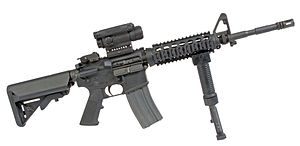
An M4 with an aftermarket buttstock, Rail Adapter System (RAS), flip-up rear sight, vertical forward grip with bipod and Aimpoint M68 CCO
Type Carbine
Place of origin  United States
Service history
In service 1994–present
Used by See Users
Wars
Production history
Manufacturer Colt Defense
Produced 1994–present
Variants M4A1, CQBR (Mk. 18 Mod 0)
Specifications
Weight 6.36 lb (2.88 kg) empty
6.9 lb (3.1 kg) with 30 rounds
Length 33 in (840 mm) (stock extended)
29.75 in (756 mm) (stock retracted)
Barrel length 14.5 in (370 mm)

Cartridge 5.56x45mm NATO
Action Gas-operated, rotating bolt
Rate of fire 700–950 round/min cyclic[1]
Muzzle velocity 2,900 ft/s or 884 m/s[1]
Effective range 500 m for a point target and 600 m for an area target[2]
Feed system 30 round box magazine or other STANAG Magazines.
Sights Iron or various optics

The M4 carbine is a family of firearms tracing its lineage back to earlier carbine versions of the M16, all based on the original AR-15 designed by Eugene Stoner and made by ArmaLite. It is a shorter and lighter version of the M16A2 assault rifle, with 80% parts commonality.[3]

It is a gas-operated, air-cooled, magazine-fed, selective fire, shoulder-fired weapon with a telescoping stock. A shortened variant of the M16A2 rifle, the M4 has a 14.5 in (370 mm) barrel, allowing the individual soldier to better operate in close quarters. The M4 has selective fire options including semi-automatic and three-round burst (like the M16A2), while the M4A1 has the capability to fire fully automatic instead of three-round burst. The carbine is also capable of mounting an M203 grenade launcher, the M203A1 with a 9-inch barrel as opposed to the standard 12-inch barrel of the M203 used on the M16 series.

The M4 carbine is slated to eventually replace the M16 rifle for most combat units in the United States Army.[4] The winner of the Individual Carbine competition may replace the M4 carbine in U.S. Army service.[5]

Contents

[hide]

History

The M4 was intended to replace the .45 ACP M3 submachine guns and selected M9 pistols and M16 rifle series with most Army units (this plan was thought to be changed with the development of the XM29 OICW and the XM8 carbine; however, both projects were canceled.)

The United States Marine Corps has ordered its officers (up to the rank of lieutenant colonel) and Staff Non-commissioned officers to carry the M4 carbine instead of the M9 handgun. This is in keeping with the Marine Corps doctrine, "Every Marine a rifleman." United States Navy corpsmen E5 and below will also be issued M4s instead of the M9.[6]

Improved M4

On July 1, 2009, the U.S. Army took complete ownership of the M4 design.[7] This will allow companies besides Colt to compete with their own M4 designs. The Army planned on fielding the last of its M4 requirement in 2010.[7] On October 30, 2009, Army weapons officials proposed a series of changes to the M4 to Congress. Requested changes include an electronic round counter that records the number of shots fired, a heavier barrel, and possibly replacing the direct impingement system with a gas piston system, the benefits of this, however, have come under scrutiny from both the military and civilian firearms community.[8][9] It should also be pointed out that, according to a PDF detailing the M4 Carbine improvement plans released by PEO Soldier, the direct impingement system will only be replaced after reviews are done comparing the direct impingement system to commercial gas piston operating system to find out and use the best available operating system in the US Army's improved M4A1. [10]

As of September 2010 the Army has announced it will buy 12,000 M4A1s from Colt Firearms by the end of 2010 and will by early 2011 order 25,000 more M4A1s. The Army announced also to have open competition for the newly designed M4 bolt carrier and gas piston operation system, which will be fitted to the newly bought M4A1 carbines. The service branch plans to buy 12,000 of these conversion kits in early 2011. In late 2011 the Army plans to buy 65,000 more conversion kits. From there the Army will decide if it will upgrade all of its M4s.[11]

Future replacement

The carbine variant of the XM8 rifle was canceled in 2005.

On November 13, 2008, the U.S. Army hosted an invitation-only Industry Day regarding a potential future replacement for the M4 carbine. Nineteen companies provided displays and briefings for military officials. The weapons displayed included the Barrett REC7 PDW, Bushmaster ACR, FN SCAR, Heckler & Koch HK416, Heckler & Koch XM8, LWRC M6A4, Robinson Arms XCR, SIG 556, as well as Colt's own improved version of the M4, the Colt ACC-M. The goal of the Industry Day was to provide officials with knowledge as to the current state of the art, which will assist the writing of a formal requirements document.[12]

The possible successor to the M4 carbine in the U.S. Army is the Individual Carbine.[5] This program is to provide a new carbine for the Army, while the USMC has decided to stay with the M4 for carbine use.[11]

Design

M4 with M68 Close Combat Optic and AN/PAQ-4
Colt Model 933, a variant of the M4 with a shorter 11.5-inch barrel, seen here fitted with an M68 CCO

The M4 and its variants fire 5.56x45mm NATO ammunition (and .223 Remington ammunition) and are gas-operated, air-cooled, magazine-fed, selective fire firearms with either a multi-position telescoping stock or a fixed A2 or LE tactical stock.[13] Original M4 models had a flat-ended telescoping stock, but newer models are now equipped with a redesigned telescoping stock that is slightly larger with curvature at the end.[14] The M4 is similar to much earlier compact M16 versions, such as the 1960s-era XM177 family. Some of those visual designs are obvious in both weapons, however most of the similarities are not very noticeable.

The M4 with the newer, redesigned telescoping stock

As with many carbines, the M4 is handy and more convenient to carry than a full-length rifle. The price is slightly inferior ballistic performance compared to the full-size M16, with its nearly 6" (15 cm) longer barrel. This becomes most apparent at ranges of 300 yards and beyond. Statistically, however, most small-arms engagements occur within 100 yards.[citation needed] This means that the M4 is very much an adequate weapon for the majority of troops. The marginal sacrifice in terminal ballistics and range, in exchange for greatly improved handling characteristics, is usually thought to be a worthwhile compromise.

While the M4's maneuverability makes it a candidate for non-infantry troops (vehicle crews, clerks and staff officers), it also makes it ideal for close quarters battle (CQB). The M4 was developed and produced for the United States government by Colt Firearms, which had an exclusive contract to produce the M4 family of weapons through 2009;[citation needed] however, a number of other manufacturers offer M4-like firearms. The M4, along with the M16A4, have mostly replaced the M16A2 in the Army and Marines. The U.S. Air Force, for example, has transitioned completely to the M4 for Security Forces squadrons, while other armed personnel retain the M16A2. The US Navy uses M4A1s for Special Operations and by vehicle crews.

Some features of the M4 and M4A1 compared to a full-length M16-series rifle include:

  • Compact size
  • Shortened barrel 14.5 in (370 mm)
  • Telescoping buttstock

However, there have been some criticisms of the carbine, such as lower muzzle velocities and louder report due to the shorter barrel, additional stress on parts because of the shorter gas system, and a tendency to overheat faster than the M16A2.

Accessories

An M4A1 just after firing, with an ejected case in mid-air; the M203 and M68 CCO are attached.

Like all the variants of the M16, the M4 and the M4A1 can be fitted with many accessories, such as night vision devices, suppressors, laser pointers, telescopic sights, bipods, either the M203 or M320 grenade launchers, the M26 MASS shotgun,forward hand grips and anything else compatible with a MIL-STD-1913 Picatinny rail.

Other common accessories include the AN/PEQ-2, Advanced Combat Optical Gunsight (ACOG), and M68 CCO. EOTech holographic weapon sights are part of the SOPMOD II package. Visible and IR (infrared) lights of various manufacturers are also commonly attached using various mounting methods. As with all versions of the M16, the M4 accepts a blank-firing attachment (BFA) for training purposes.

Feedramps

M4 feedramps are extended from the barrel extension into the upper receiver. This can help alleviate feeding problems which may occur as a result of the increased pressure of the shortened gas system of the M4. This problem is primarily seen in full-auto applications. While some feel they are unnecessary, their perceived or real utility to others has led to the increasing availability of this feature on civilian AR-15 products.[citation needed]

Variants

Except for the very first delivery order, all U.S. military-issue M4 and M4A1 carbines possess a flat-top NATO M1913-specification (Picatinny) rail on top of the receiver for attachment of optical sights and other aiming devices — Trijicon TA01 and TA31 Advanced Combat Optical Gunsights (ACOG), EOTech 550 series holographic sights, and Aimpoint M68 Close Combat Optic (M68 CCO) being the favorite choices — and a detachable rail-mounted carrying handle. Standards are the Colt Model 920 (M4) and 921 (M4A1).

Variants of the carbine built by different manufacturers are also in service with many other foreign special forces units, such as the Australian Special Air Service Regiment (SASR). While the SASR uses weapons of essentially the same pattern built by Colt for export (Colt uses different models to separate weapons for the U.S. military and those for commercial/export purposes), the British SAS uses a variant on the basic theme, the Colt Canada (formerly Diemaco) C8SFW.

The M4 carbine is slated to eventually replace the M16 rifle in the United States Army.[4]

M4 MWS (Modular Weapon System)

M4 MWS (Modular Weapon System) shown with various accessories including M203 grenade launcher, RIS foregrip, removable carry handle/rear sight assembly, AN/PEQ-4 laser system, M68 CCO reflex sight, and the AN/PVS-4 night vision optics

Colt Model 925 carbines were tested fitted with the Knight's Armament Corporation (KAC) M4 RAS under the designation M4E2, but this designation appears to have been scrapped in favor of mounting this system to existing carbines without changing the designation. The U.S. Army Field Manual specifies for the Army that adding the Rail Adapter System (RAS) turns the weapon into the M4 MWS or Modular Weapon System.

M4A1

The M4A1 carbine is a fully automatic variant of the basic M4 carbine intended for special operations use. The M4A1 has a "S-1-F" (safe/semi-automatic/fully automatic) trigger group, while the M4 has a "S-1-3" (safe/semi-automatic/3-round burst) trigger group. The M4A1 is used by almost all[which?] U.S special operation units. The M4A1 is especially favored by counter-terrorist and special forces units for close quarters combat because of the carbine's compactness and firepower.[citation needed] These features are also very useful in urban warfare. It has a maximum effective range of about 500 to 600 meters (550–660 yd).[2]

All U.S. Army forces will begin replacing their basic M4 carbines and all 600,000 M16 rifles with the M4A1 variant in 2014. The M4A1 in turn would likely be replaced with the Individual Carbine. Replacement of the M16 would come from the Individual Carbine instead of the M4A1 if procurement was attained.[15]

In the last few years, M4A1 carbines have been refit or received straight from factory with barrels with a thicker profile under the handguard. This is for a variety of reasons such as heat dissipation, which is useful due to the complaints of high-heat production from test soldiers, which occurs during full-auto and accuracy as a byproduct of barrel weight. These heavier barrel weapons are also fitted with a heavier buffer known as the H2. Out of three sliding weights inside the buffer, the H2 possesses two tungsten weights and one steel weight, versus the standard H buffer, which uses one tungsten weight and two steel weights. These weapons, known by Colt as the Model 921HB (for Heavy Barrel), have also been designated M4A1, and as far as the government is concerned the M4A1 represents both the 921 and 921HB.

Mark 18 CQBR

Current contractor for the Mark 18 is Colt & Lewis Machine & Tool NSN 1005-01-527-2288. It is equipped with a 10.3" barrel.[citation needed]

SOPMOD Block I
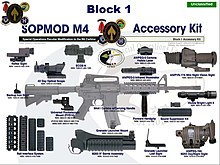
SOPMOD (Special Operations Peculiar Modification) Block I

USSOCOM developed the Special Operations Peculiar Modification (SOPMOD) Block I kit for the carbines used by units under its jurisdiction. The kit features an M4A1, a Rail Interface System (RIS) handguard developed by Knight's Armament Company, a shortened quick-detachable M203 grenade launcher and leaf sight, a KAC sound suppressor, a KAC back-up rear sight, an Insight Technologies AN/PEQ-2A visible laser/infrared designator, along with Trijicon's ACOG and Reflex sights, and a night vision sight. This kit was designed to be configurable (modular) for various missions, and the kit is currently in service with special operations units.

SOPMOD Block II

A second-generation SOPMOD kit (now known as SOPMOD II) includes innovative optics, such as the Elcan Specter DR and the Eotech 553. Block II uses the RIS II rails manufactured by Daniel Defense in both a 9.5 and 12.5 length.

SOPMOD Block III

2012-XXXX SOPMOD 1 & 2 Compatible with both M4A1 Carbine & SCAR SOPMOD 2 Compatibilities with all SOF Weapons[citation needed]

Performance

2007 dust test

In the fall 2007, the Army tested the M4 against three other carbines in "sandstorm conditions" at Aberdeen Proving Ground, Maryland: the Heckler & Koch XM8, Fabrique Nationale de Herstal SOF Combat Assault Rifle (SCAR) and the Heckler & Koch HK416. Ten of each type of rifle were used to fire 6,000 rounds each, for a total of 60,000 rounds per rifle type.[16] The M4 suffered far more stoppages than its competitors: 882 stoppages, 19 requiring an armorer to fix. The XM8 had the fewest stoppages, 116 minor stoppages and 11 major ones, followed by the FN SCAR with 226 stoppages and the HK416 with 233.[17][18] The Army was quick to point out that even with 863 minor stoppages—termed "class one" stoppages which require 10 seconds or less to clear and "class two" stoppages which require more than ten seconds to clear—the M4 functioned well, with over 98 percent of the 60,000 total rounds firing without a problem. The Army said it planned to improve the M4 with a new cold-hammer-forged barrel to give longer life and more reliable magazines to reduce the stoppages. Magazine failures caused 239 of the M4's 882 failures. Army officials said the new magazines could be combat-ready by spring if testing went well.[19]

Gas Piston

Complicating the Army search for higher reliability in the M4 is a number of observations of M4 gas piston alternatives that suffer unintended design problems. The first is that many of the gas piston modifications for the M4 isolate the piston so that piston jams or related malfunction require the entire weapon be disassembled, such disassembly cannot be performed by the end user and requires a qualified armorer to perform out of field, where as any malfunction with the direct-impingement system can be fixed by the end user in field. The second is that gas piston alternatives use an off-axis operation of the piston that can introduce carrier tilt, whereby the bolt carrier fails to enter the buffer tube at a straight angle resulting in part wearing. The third is that the use of a sound suppressor results in hot gases entering the chamber, regardless of a direct-gas impingement or gas piston design choice. The gas-piston system also causes the firearm to become proprietary to the manufacturer, making modifications and changes with parts from other manufacturers difficult.[20][9] The argument for a gas piston is that it would reduce fouling; the argument against is that is would increase weight and reduce accuracy. The issue remains contentious and unresolved.[citation needed]

Trademark issues

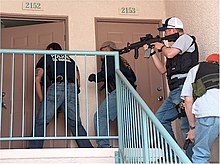
A U.S. Marshal covers a doorway with an M4.

Colt previously held a U.S. trademark on the term "M4".[21] Many manufacturers have production firearms that are essentially identical to a military M4. Civilian models are sometimes colloquially referred to as "M4gery"[22] (play /ɛmˈfɔərəri/,[23] a portmanteau of "M4" and "forgery"). Colt had maintained that it retains sole rights to the M4 name and design. Other manufacturers had long maintained that Colt had been overstating its rights, and that "M4" had now become a generic term for a shortened AR-15. In April 2004, Colt filed a lawsuit against Heckler & Koch and Bushmaster Firearms, claiming acts of trademark infringement, trade dress infringement, trademark dilution, false designation of origin, false advertising, patent infringement, unfair competition, and deceptive trade practices. Heckler & Koch later settled out of court, changing one product's name from "HK M4" to "HK416". However, on December 8, 2005, a District court judge in Maine granted a summary judgment in favor of Bushmaster Firearms, dismissing all of Colt's claims except for false advertising. On the latter claim, Colt could not recover monetary damages. The court also ruled that "M4" was now a generic name, and that Colt's trademark should be revoked.[24]

Users

A member of the Philippine Special Action Force holding a M4 Carbine while guarding the U.S. Embassy in Manila.
Indonesian police unit, Detachment 88
Members of the Serbian SAJ, the one in the center holding a Colt Model 933 while the one on the left holds a SIG SG 552.
Officers of the Police Special Operations Battalion of Rio de Janeiro (BOPE-RJ) Using the Colt 933 assault rifle while doing an operation in a favela in Rio de Janeiro, Brazil
تاریخ : دوشنبه 11 مهر 1390
نویسنده : konami

Heckler & Koch MP5

From Wikipedia, the free encyclopedia
 
Jump to: navigation, search
Heckler & Koch MP5

 
Type Submachine gun
Personal defense weapon (MP5-K versions)
Place of origin  West Germany
Service history
In service 1966–present
Used by See Users
Production history
Designer Tilo Möller, Manfred Guhring, Georg Seidl, Helmut Baureuter
Designed 1964–1966
Manufacturer Heckler & Koch
Produced 1966–present
Variants See Variants
Specifications
Weight 2.54 kg (5.60 lb) (MP5A2, MP5A4)
3.08 kg (6.8 lb) (MP5A3, MP5A5)
2 kg (4.4 lb) (MP5K, MP5KA1, MP5KA4, MP5KA5)
2.78 kg (6.1 lb) (MP5K-PDW)
2.80 kg (6.2 lb) (MP5SD1, MP5SD4)
3.10 kg (6.8 lb) (MP5SD2, MP5SD5)
3.60 kg (7.9 lb) (MP5SD3, MP5SD6)
2.67 kg (5.9 lb) fixed stock / 2.85 kg (6.3 lb) retractable stock (MP5/10)
2.67 kg (5.9 lb) fixed stock / 2.85 kg (6.3 lb) retractable stock (MP5/40)
Length Fixed stock: 680 mm (27 in) (MP5A2, MP5A4, MP5/10, MP5/40)
790 mm (31.1 in) (MP5SD2, MP5SD5)
Telescoping stock: 700 mm (27.6 in) stock extended / 550 mm (21.7 in) stock collapsed (MP5A3, MP5A5)
603 mm (23.7 in) stock extended / 368 mm (14.5 in) stock folded (MP5K-PDW)
805 mm (31.7 in) stock extended / 670 mm (26.4 in) stock collapsed (MP5SD3, MP5SD6)
660 mm (26.0 in) stock extended / 490 mm (19.3 in) stock collapsed (MP5/10, MP5/40)
Receiver end cap: 325 mm (12.8 in) (MP5K, MP5KA1, MP5KA4, MP5KA5)
349 mm (13.7 in) (MP5K-PDW)
550 mm (21.7 in) (MP5SD1, MP5SD4)
Barrel length 225 mm (8.9 in) (MP5A2, MP5A3, MP5A4, MP5A5, MP5/10, MP5/40)
115 mm (4.5 in) (MP5K, MP5KA1, MP5KA4, MP5KA5, MP5K-PDW)
146 mm (5.7 in) (MP5SD1, MP5SD2, MP5SD3, MP5SD4, MP5SD5, MP5SD6)
Width 50 mm (2.0 in) (MP5A2, MP5A3, MP5A4, MP5A5, MP5K, MP5KA1, MP5KA4, MP5KA5, MP5K-PDW, MP5/10, MP5/40)
60 mm (2.4 in) (MP5SD1, MP5SD2, MP5SD3, MP5SD4, MP5SD5, MP5SD6)
Height 260 mm (10.2 in) (MP5A2, MP5A3, MP5A4, MP5A5, MP5SD1, MP5SD2, MP5SD3, MP5SD4, MP5SD5, MP5SD6, MP5/10, MP5/40)
210 mm (8.3 in) (MP5K, MP5KA1, MP5KA4, MP5KA5, MP5K-PDW)

Cartridge 9x19mm Parabellum
10mm Auto (MP5/10)
.40 S&W (MP5/40)
Action Roller-delayed blowback, closed bolt
Rate of fire 700 rounds/min (MP5SD series), 800 rounds/min (MP5A series, MP5/10 and MP5/40), 900 rounds/min (MP5K series)
Muzzle velocity 400 m/s (1,312 ft/s) (MP5A2, MP5A3, MP5A4, MP5A5)
375 m/s (1,230.3 ft/s) (MP5K, MP5KA1, MP5KA4, MP5KA5, MP5K-PDW)
285 m/s (935.0 ft/s) (MP5SD1, MP5SD2, MP5SD3, MP5SD4, MP5SD5, MP5SD6)
425 m/s (1,394.4 ft/s) (MP5/10)
315 m/s (1,033.5 ft/s) (MP5/40)
Effective range 200 m (656 ft) (MP5A2, MP5A3, MP5A4, MP5A5), 100 m (328 ft) (MP5/10), 50 m (164 ft) (MP5/40), 100 m (328 ft) (MP5K, MP5KA1, MP5KA4, MP5KA5, MP5K-PDW)
Feed system 15- or 30- or 32- round detachable box magazine, 100-round Beta C-Mag drum magazine
Sights Iron sights. Rear: rotary drum; front: hooded post

The Heckler & Koch MP5 (from German: Maschinenpistole 5, "machine pistol model 5") is a 9mm submachine gun of German design, developed in the 1960s by a team of engineers from the German small arms manufacturer Heckler & Koch GmbH (H&K) of Oberndorf am Neckar.

The MP5 is currently one of the most widely used submachine guns in the world,[1] having been adopted by numerous military, law enforcement, intelligence and security organizations. In the 1990s, Heckler & Koch developed the Heckler & Koch UMP, the MP5's successor, though both remain in production.[2]

Contents

[hide]

[edit] History

A SEAL Team 8 member armed with an MP5-N variant.

Heckler & Koch, encouraged by the success of the G3 automatic rifle, developed a family of small arms consisting of four types of firearms (all based on a common G3 design layout and operating principle), where the first type was chambered in 7.62x51mm NATO, the second—using the 7.62x39mm M43 round, third—the intermediate 5.56x45mm NATO caliber and the fourth type—chambering the 9x19mm Parabellum pistol cartridge. The MP5 was created within the fourth group of firearms and was initially known as the HK54.

Work on the MP5 began in 1964 and scarcely two years later it was adopted by the German Federal Police, border guard and army special forces.

The MP5 is manufactured under license in several nations including Greece (formerly at EBO - Hellenic Arms Industry, currently at EAS - Hellenic Defense Systems), Iran (Defense Industries Organization), Mexico (SEDENA), Pakistan (Pakistan Ordnance Factories), Saudi Arabia, Sudan (Military Industry Corporation), Turkey (MKEK), and the United Kingdom (initially at Royal Ordnance, later diverted to Heckler & Koch Great Britain).[3]

[edit] Design details

The primary version of the MP5 family is the MP5A2, which is a lightweight, air-cooled, selective fire delayed blowback operated 9x19mm Parabellum weapon with a roller-delayed bolt. It fires from a closed bolt (bolt forward) position.

The fixed, free floating, cold hammer-forged barrel has 6 right-hand grooves with a 1 in 250 mm (1:10 in) rifling twist rate and is pressed and pinned into the receiver.

[edit] Features

The first MP5 models used a double-column straight box magazine, but since 1977, slightly curved, steel magazines are used with a 15-round capacity (weighing 0.12 kg) or a 30-round capacity (0.17 kg empty).

A view through the weapon's aperture sight.

The adjustable iron sights (closed type) consist of a rotating rear diopter drum and a front post installed in a hooded ring. The rear sight is adjustable for both windage and elevation with the use of a special tool; the drum provides four different apertures of varying width used for firing at 25, 50, 75 and 100 m.

The MP5 has a hammer firing mechanism. The trigger group is housed inside an interchangeable polymer trigger module (with an integrated pistol grip) and equipped with a 3-position fire mode selector that serves as the manual safety toggle. The “S” or Sicher position in white denotes weapon safe, “E” or Einzelfeuer in red represents single fire, and “F” or Feuerstoß (also marked in red) designates continuous fire. The SEF symbols appear on both sides of the plastic trigger group. The selector lever is actuated with the thumb of the shooting hand and is located only on the left side of the original SEF trigger group or on both sides of the ambidextrous trigger groups. The safety/selector is rotated into the various firing settings or safety position by depressing the tail end of the lever. Tactile clicks (stops) are present at each position to provide a positive stop and prevent inadvertent rotation. The "safe" setting disables the trigger by blocking the hammer release with a solid section of the safety axle located inside the trigger housing.

The non-reciprocating cocking handle is located above the handguard and protrudes from the cocking handle tube at approx. a 45° angle. This rigid control is attached to a tubular piece within the cocking lever housing called the cocking lever support, which in turn, makes contact with the forward extension of the bolt group. It is not however connected to the bolt carrier and therefore cannot be used as a forward assist to fully seat the bolt group. The cocking handle is held in a forward position by a spring detent located in the front end of the cocking lever support which engages in the cocking lever housing. The lever is locked back by pulling it fully to the rear and rotating it slightly clockwise where it can be hooked into an indent in the cocking lever tube.

[edit] Operating mechanism

The bolt rigidly engages the barrel extension – a cylindrical component welded to the receiver into which the barrel is pinned. The delay mechanism is of the same design as that used in the G3 rifle. The two-part bolt consists of a bolt head with rollers and a bolt carrier. The heavier bolt carrier lies up against the bolt head when the weapon is ready to fire and inclined planes on the front locking piece lie between the rollers and force them out into recesses in the barrel extension.[4]

The roller-delayed blowback mechanism originated from the aborted StG 45(M) assault rifle prototypes developed in Nazi Germany at the end of World War II.

When fired, expanding propellant gases produced from the burning powder in the cartridge exert rearward pressure on the bolt head transferred through the base of the cartridge case as it is propelled out of the chamber. A portion of this force is transmitted through the rollers projecting from the bolt head, which are cammed inward against the inclined flanks of the locking recesses in the barrel extension and to the angled shoulders of the locking piece. The selected angles of the recesses and the incline on the locking piece produce a velocity ratio of about 4:1 between the bolt carrier and the bolt head. This results in a calculated delay, allowing the projectile to exit the barrel and gas pressure to drop to a safe level before the case is extracted from the chamber.

A British police officer guarding Downing Street with an MP5SFA3 semi-automatic carbine fitted with an underbarrel torch and an EOtech holographic sight.

The delay results from the amount of time it takes for enough recoil energy to be transferred through to the bolt carrier in a sufficient quantity for it to be driven to the rear against the force of inertia of the bolt carrier and the forward pressure exerted against the bolt by the recoil spring. As the rollers are forced inward they displace the locking piece and propel the bolt carrier to the rear. The bolt carrier's rearward velocity is four times that of the bolt head since the cartridge remains in the chamber for a short period of time during the initial recoil impulse. After the bolt carrier has traveled rearward 4 mm, the locking piece is withdrawn fully from the bolt head and the rollers are compressed into the bolt head. Only once the locking rollers are fully cammed into the bolt head can the entire bolt group continue its rearward movement in the receiver, breaking the seal in the chamber and continuing the feeding cycle.

Since the 9x19mm Parabellum cartridge is relatively low powered, the bolt does not have an anti-bounce device like the G3, but instead the bolt carrier contains tungsten granules that prevent the bolt group from bouncing back after impacting the barrel extension. The weapon has a fluted chamber that enhances extraction reliability by bleeding gases backwards into the shallow flutes running along the length of the chamber to prevent the cartridge case from expanding and sticking to the chamber walls (since the bolt is opened under relatively high barrel pressure). A spring extractor is installed inside the bolt head and holds the case securely until it strikes the ejector arm and is thrown out of the ejection port to the right of the receiver. The lever-type ejector is located inside the trigger housing (activated by the movement of the recoiling bolt).

[edit] Accessories

Royal Malaysian Navy commandos armed with MP5s.

Three lugs are provided at the muzzle that are used to work with certain muzzle devices made by Heckler & Koch, including: a slotted flash suppressor, blank firing attachment (marked with a red painted band denoting use with blank ammunition only), an adaptor for launching rifle grenades (for use with rifle-style grenades with an inside diameter of 22 mm using a special grenade launching cartridge) and a cup-type attachment used to launch tear gas grenades.

The receiver housing has notches that permit the attachment of a standard Heckler & Koch quick-detachable scope mount (also used with the G3, HK33 and G3SG/1) that can be used to mount daytime optical sights (telescopic 4x24), night sights or a halogen flashlight. It can be used with reflex sights and laser pointers. The mount features two spring-actuated bolts, positioned along the base of the mount, which exert pressure on the receiver to hold the mount in the same position at all times assuring zero retention. All versions of the quick-detachable scope mount provide a sighting tunnel through the mount so that the shooter can continue to use the fixed iron sights with the scope mount attached to the top of the receiver.

[edit] Variants

The Heckler & Koch MP5 submachine gun is widely used by law enforcement, tactical teams and military forces. Seen here is the MP5A3 variant with the early 'slimline' handguard.

The MP5A2 has a fixed stock (made of a synthetic polymer), whereas the compact MP5A3 has a retractable metal stock.

In the early 1970s HK introduced a conversion kit for the MP5 that enables it to use sporting ammunition (.22 LR). This unit consists of a barrel insert, a bolt group and two 20-round magazines. This modification reduces the cyclic rate to 650 rounds/min.

The MP5A2 and MP5A3 are available with optional 4-position trigger groups; these are known as the MP5A4 and MP5A5 respectively. The trigger groups are marked with bullet pictograms rather than letters or numbers (each symbol represents the number of bullets that will be fired when the trigger is pulled and held rearward with a full magazine inserted in the weapon) and are fully ambidextrous (the selector lever is present on each side of the trigger housing). The additional setting of the fire selector, one place before the fully automatic setting, enables a two or three-shot burst firing mode. H&K offers dedicated training variants of these weapons, designated MP5A4PT and MP5A5PT (PT – Plastic Training), modified to fire a plastic 9x19mm PT training cartridge produced by Dynamit Nobel of Germany. These weapons operate like the standard MP5 but have a floating chamber and the bolt lacks both rollers to function properly when firing the lighter plastic projectiles. To help identify these weapons blue dots were painted on their cocking handles and additional lettering provided. The PT variant can be configured with various buttstocks and trigger groups and was developed for the West German Police and Border Guard.

A U.S. Marine fires an MP5.

The modular design of the MP5 offers multiple trigger groups: three-position "SEF" fire selector (positions: "S"-safe, "E"-semi automatic, "F" fully automatic. Located on left of receiver only); three-position fire selector (positions: safe, semiautomatic and a 2 or 3-round burst; selector lever is ambidextrous and its settings are marked with pictograms); four-position fire selector (positions: weapon safe, single fire, 2 or 3-round burst, full auto; ambidextrous selector; selector settings marked with pictograms); two-position fire control group (positions: weapon safe, single fire only; ambidextrous selector lever with pictograms) and a three-position fire selector group – the so called “Navy” trigger (settings: weapon safe, semi-automatic, fully automatic fire; ambidextrous selector lever; selector settings marked with bullet symbols again).

A USMC Military Police Special Reaction Team using the MP5-N.

A variant with the last trigger group designated the MP5-N (N – Navy) was developed in 1986 for the United States Navy. This model has a collapsible stock, a tritium-illuminated front sight post and a 225 mm (8.9 in) threaded barrel for use with a stainless steel sound suppressor made by Knight's Armament Company together with quieter subsonic ammunition.

[edit] Civilian variants

The MP5SFA2 (SF - single-fire) is the same as the MP5A2 but is fitted with an ambidextrous semi-automatic only trigger group. Versions delivered after December 1991 are assembled with select-fire bolt carriers allowing fully automatic operation when used with the appropriate trigger module. Developed in 1986 in response to the American FBI solicitation for "9 mm Single-fire Carbines". The MP5SFA3 features a retractable metal stock.

The two-position trigger unit was used in the single-fire HK94 carbine that was produced specifically for the civilian market with a 420 mm (16.5 in) barrel.

[edit] Suppressed variants

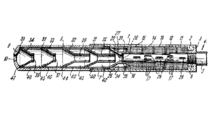
In 1974 H&K initiated design work on a sound-suppressed variant of the MP5, designated the MP5SD (SD – Schalldämpfer German for "sound suppressor"), which features an integral but detachable aluminium sound suppressor and a lightweight bolt. The weapon's 146 mm (5.7 in) barrel has 30 2.5 mm (0.1 in) ports drilled forward of the chamber through which escaping gases are diverted to the surrounding sealed tubular casing that is screwed on to threading on the barrel’s external surface just prior to the ported segment. The suppressor itself is divided into two stages; the initial segment surrounding the ported barrel serves as an expansion chamber for the propellant gases, reducing gas pressure to slow down the acceleration of the projectile. The second, decompression stage occupies the remaining length of the suppressor tube and contains a stamped metal helix separator with several compartments which increase the gas volume and decrease its temperature, deflecting the gases as they exit the muzzle, so muffling the exit report. The bullet leaves the muzzle at subsonic velocity, so it does not generate a sonic shock wave in flight. As a result of reducing the barrel’s length and venting propellant gases into the suppressor, the bullet’s muzzle velocity was lowered anywhere from 16% to 26% (depending on the ammunition used) while maintaining the weapon’s automation and reliability. The weapon was designed to be used with standard supersonic ammunition with the suppressor on at all times.

The MP5SD is produced exclusively by H&K in several versions: the MP5SD1 and MP5SD4 (both have a receiver end cap instead of a buttstock), MP5SD2 and MP5SD5 (equipped with a fixed synthetic buttstock) and the MP5SD3 and MP5SD6 (fitted with a collapsible metal stock). The MP5SD1, MP5SD2 and MP5SD3 use a standard "SEF" trigger group (from the MP5A2 and MP5A3), while the MP5SD4, MP5SD5 and MP5SD6 – a trigger module with a mechanically limited 3-round burst mode and ambidextrous selector controls (from the MP5A4 and MP5A5). A suppressed version was produced for the U.S. Navy - designated the MP5SD-N, which is a version of the MP5SD3 with a retractable metal stock, front sight post with tritium-illuminated dot and a stainless steel suppressor. This model has a modified cocking handle support to account for the slightly larger outside diameter of the suppressor. The design of the suppressor allows the weapon to be fired with water inside, should water enter the device during operation in or near water.

[edit] MP5K

USAF OSI Special Agent firing a RAAF Air Traffic Control Detachment MP5K at the Baghdad International Airport firing range.
U.S. Navy SEALs armed with MP5s on a training exercise.

In 1976 a shortened version of the MP5A2 was introduced; the MP5K (K from the German word Kurz = "short") was designed for close quarters battle use by clandestine operations and special services. The MP5K does not have a shoulder stock (the receiver end was covered with a flat end cap, featuring a buffer on the inside and a sling loop on the outside), and the bolt and receiver were shortened at the rear. The resultant lighter bolt led to a higher rate of fire than the standard MP5. The barrel, cocking handle and its cover were shortened and a vertical foregrip was used to replace the standard handguard. The barrel ends at the base of the foresight, which prevents the use of any sort of muzzle device.

The MP5K is produced (by Heckler & Koch and under license in Iran and Turkey) in four different versions: the MP5K, MP5KA4, MP5KA1, MP5KA5, where the first two variants have adjustable, open-type iron sights (with a notched rotary drum), and the two remaining variants - fixed open sights, however the front sight post was changed and a notch was cut into the receiver top cover. The MP5K retained the capability to use optical sights through the use of an adapter.

A civilian semiautomatic derivative of the MP5K known as the SP89 was produced that had a foregrip with a muzzle guard in place of the vertical grip.

In 1991 a further variant of the MP5K was developed, designated the MP5K-PDW (PDW – Personal Defense Weapon) that retained the compact dimensions of the MP5K but restored the fire handling characteristics of the full-size MP5A2. The MP5K-PDW uses a side-folding synthetic shoulder stock (made by the U.S. company Choate Machine and Tool), a “Navy” trigger group, a front sight post with a built-in tritium insert and a slightly lengthened threaded, three-lug barrel (analogous to the MP5-N). The stock can be removed and replaced with a receiver endplate; a rotary drum with apertures from the MP5A2 can also be used.

[edit] Larger caliber versions

In 1991, Heckler & Koch introduced the MP5/10 (chambered in 10mm Auto) and MP5/40 (chambered for the .40 S&W cartridge), which are based on the MP5A4 and MP5A5. These weapons were assembled in fixed and retractable stock configurations (without a separate designation) and are fed from translucent 30-round polymer box magazines.[5] These weapons include a bolt hold-open device, which captures the bolt group in its rear position after expending the last cartridge from the magazine. The bolt is then released by pressing a lever positioned on the left side of the receiver. Both weapons use a barrel with 6 right-hand grooves and a 380 mm (1:15 in) twist rate, and like the MP5-N, both have a 3-lugged muzzle device and a tritium-illuminated front sight aiming dot.

[edit] Variants list

Cross section diagram of an MP5SD early model suppressor, from 1971 patent. Vented barrel surrounded by metal mesh packing in the expansion chambers, followed by conical baffles in the forward chambers.
MP5K-PDW (early prototype, lacking 'Navy' trigger group and lugged barrel).
The MP5SD3.
A Turkish gendarmerie on guard at Topkapı Palace with the MP5
  • HK54: The original model that was produced in the mid 1960s. It later became known as the MP5A1, a very slightly modified version. No buttstock (endplate/receiver cap in place of buttstock), "Navy"/"SEF" trigger group.
  • MP5A2: Fixed buttstock, "SEF" trigger group.
  • MP5SFA2: Fixed buttstock, single-fire (SF) trigger group.
  • MP5A3: Retractable buttstock,"SEF" trigger group.
  • MP5SFA3: Retractable buttstock, single-fire (SF) trigger group.
  • MP5A4: Fixed buttstock, 3-round burst trigger group.
  • MP5A5: Retractable buttstock, 3-round burst trigger group.
  • MP5-N: Model developed specifically for the U.S. Navy. Ambidextrous "Navy" trigger group, 3-lug/threaded barrel for attaching a sound suppressor; retractable stock.
  • MP5F: Model developed specifically for the French military. Rubber-padded retractable stock, ambidextrous sling loops/bolts and internal modifications to handle high-pressure ammunition.
  • MP5K: Short (Kurz) version, "SEF" trigger group.
    • MP5KA1: MP5K with smooth upper surface and small iron sights; "SEF" trigger group.
    • MP5KA4: MP5K with 3-round burst trigger group.
    • MP5KA5: MP5KA1 with 3-round burst trigger group.
    • MP5K-N: MP5K with "Navy" trigger group and 3-lug/threaded barrel for mounting suppressors or other muzzle attachments.
    • MP5K-PDW: Personal Defense Weapon; MP5K-N with added folding stock and 3-lug/threaded barrel for mounting of suppressors; "Navy" or 3-round burst trigger group. Introduced in 1991.
  • MP5SD1: No buttstock (endplate/receiver cap in place of buttstock), "SEF" trigger group, integrated suppressor (Schalldämpfer)
  • MP5SD2: Fixed buttstock, "SEF" trigger group, integrated suppressor.
  • MP5SD3: Retractable buttstock, "SEF" trigger group, integrated suppressor.
  • MP5SD4: No buttstock (endplate/receiver cap in place of buttstock), 3-round burst trigger group, integrated suppressor.
  • MP5SD5: Fixed buttstock, 3-round burst trigger group, integrated suppressor.
  • MP5SD6: Retractable buttstock, 3-round burst trigger group, integrated suppressor.
  • MP5SD-N1: Retractable buttstock, "Navy" trigger group, KAC stainless steel suppressor.
  • MP5SD-N2: Fixed buttstock, "Navy" trigger group, KAC stainless steel suppressor.
  • MP5/10: Chambered in 10mm Auto, available in various stock/trigger group configurations. It was produced from 1992 to 2000.
  • MP5/40: Chambered in .40 S&W, available in various stock/trigger group configurations. It was produced from 1992 to 2000.
  • HK94: American import model of the MP5 with a 16 in barrel and special safe/semi-automatic trigger group, designed for civilian use. It was made from 1983 to 1989, in three different configurations.
  • SP89: Sport Pistole M1989. Semi-automatic only version of the MP5K designed for civilian use. It had a modified foregrip redesigned into a traditional handguard to make it compliant with the Semi-Auto Weapons Ban of 1989. It was made from 1989 to 1994.

[edit] Users


|
امتیاز مطلب : 0
|
تعداد امتیازدهندگان : 0
|
مجموع امتیاز : 0
تاریخ : جمعه 10 تیر 1390
نویسنده : konami

نقاشی های زیبا و دیدنی از Victor Kaganov


نقاشی های زیبا و دیدنی از Bob Ross


|
امتیاز مطلب : 0
|
تعداد امتیازدهندگان : 0
|
مجموع امتیاز : 0
تاریخ : جمعه 10 تیر 1390
نویسنده : konami

گزارش تصویری: نقاشی‌های نویسندگان بزرگ جهان

اما اگر این خط‌خطیها، نقاشیها یا طرحها را مثلا نویسنده بزرگی کشیده باشد که بسیار دوستش می‌‌داریم، آن وقت هر قدر هم که از نظر...
 

شاید شما هم بارها قلم به دست گرفته‌اید و بر روی کاغذ یا کنار روزنامه، بر روی صفحات تقویم یا روی پاکتنامه و خلاصه هر جایی که یک تکه کاغذ سفید گیرتان آمده، خطخطی کرده‌اید و چیزی که ناخودآگاه در ذهنتان آمده، بر روی آن صفحه کشیده‌اید. بعضیها هم مثلا وقتی پای تلفن صحبتشان به درازا می‌کشد همین کار را می‌کنند و بر روی هر صفحه‌ای که روبرویشان باشد، خط خطی می‌کنند و طرح می‌کشند. هر چقدر که استعدادتان در نقاشی کردن بهتر باشد، نقاشی، طرح یا خلاصه هر آن چیزی که بر روی صفحه کاغذ کشیده اید، بهتر از کار در خواهد آمد. غالبا این نقاشی‌ها به سطل آشغال سپرده می‌شوند و گاهی اگر از آن خوشمان بیاید لای دفتر یا کتابی آن را نگه می‌داریم. وقتی سالها از آن نقاشی می‌گذرد و نگاهی به آن می‌اندازیم، بیشتر از آن که ارزش هنری داشته باشد، ما را یاد خاطرهای در سالیان گذشته می‌اندازد. اما اگر این خط‌خطیها، نقاشیها یا طرحها را مثلا نویسنده بزرگی کشیده باشد که بسیار دوستاش می‌‌داریم، آن وقت هر قدر هم که از نظر هنری بی‌ارزش باشد، دیدنش برایمان مهم می‌شود. وقتی نویسنده یا شاعری را می‌پرستیم، عکسهایش را جمع می‌کنیم، صدایش را گوش می‌دهیم، دستخطش را نگاه می‌‌داریم و خلاصه هر چیز بی‌ارزشی که از او باشد، ناگهان برایمان گرانبها می‌شود. نوزده ژانویه تا شش آوریل نیز نمایشگاهی از نقاشیها و طرحهای نویسندگان بزرگی چون مارسل پروست، پل ورلن، ژان کوکتو، آلن روبگریه، آندره برتون، رولان بارت و خیلی‌ها دیگر در شهر پاریس برگزار شد. این نقاشی‌ها عموما از سه منبع تهیه شده و در این نمایشگاه در معرض عموم قرار گرفته بود. تعدادی از آنها از مجموعه های شخصی و تعدادی از مجموعه بزرگ «پیر بلفوند» ناشر معروف فرانسوی و تعدادی هم از آرشیو موسسه‌ی «ایمک» فرانسه فراهم شده بود. عکسهایی که در زیر می‌بینید، عکسهایی است که «زوران میکلئوزویک» گرفته و در شماره‌ی ۴۷۱ ماهنامه «مگزین لیتهرر» در مقالهای که به مناسبت برگزاری همین نمایشگاه نوشته شده، منتشر شده است.


|
امتیاز مطلب : 0
|
تعداد امتیازدهندگان : 0
|
مجموع امتیاز : 0
تاریخ : جمعه 10 تیر 1390
نویسنده : konami

شاهکارهای نقاشی هنرمندان بزرگ جهان+تصاویر

هنر تنها زیبایی دوباره خلق شده نیست؛ هنر تجلی عشق، مهربانی و عمیق‌ترین احساسات قلبی است. آیا به الهام و انگیزه نیاز دارید؟ پس به این نقاشی‌‌ها...
 
هنر خالق زیبایی‌‌هاست.
رالف والدو امرسون
من خودم هنرمند نیستم و در خلق کارهای هنری نیز ماهر نیستم، اما همیشه شاهکارهای بزرگ هنر بهم انگیزه می‌دهند. هنر تنها زیبایی دوباره خلق شده نیست؛ هنر تجلی عشق، مهربانی و عمیق‌ترین احساسات قلبی است. آیا به الهام و انگیزه نیاز دارید؟ پس به این نقاشی‌‌ها نگاه کنید! کلمه‌ای برای وصف زیبایی‌شان پیدا نمی‌شود... چه چیزی بیشتر از یک شاهکار بزرگ می‌تواند الهام بخش باشد؟
 

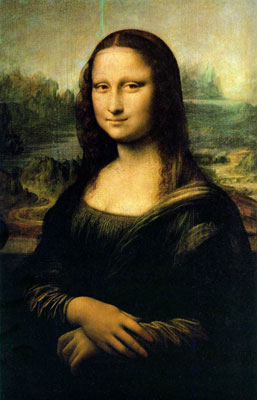
مونالیزا، لئوناردو داوینچی
لوور، پاریس- 06-1503
این صورت با لبخند مرموزش خودش با هنر مترادف شده است و قطعا مشهورترین نقاشی ای است که همه‌مان می‌شناسیم و تقریبا تاثیرگذارترین پرتره در طول تاریخ نیز بوده است.


شب پرستاره، وینسنت ون گوک

موزه هنرهای معاصر، نیویورک، 1889
بی شک این اثر هنریبهترین دوست داشتنی‌‌ها را به نمایش گذاشته و اما نوابغ را نیز به دردسر انداخته است. گویا هنرمند قصد داشته در طول نیم قرن یا بیشتر با استفاده پرمعنی اش از رنگ نوابغ و هنرمندان سراسر جهان را تحت تاثیر قرار دهد.
 
 
گلهای آفتابگردان، وینسنت ون گوک
لندن، گالری ملی، 1888
ون گوک بعد از ترک کردن زادگاهش هلند به قصد جنوب فرانسه برای تشکیل انجمن هنری، این گلهای آفتابگردان را نقاشی کرده است. او این اثر را برای تزئین اتاق خواب دوستش پل گوگن نقاشی کرد. ون گوک سال بعد یعنی سال 1889 کپی دیگری نیز از این نقاشی کشید و شاید هم کپی دیگری در سال بعدتر. کپی‌‌ها و نسخه‌‌های متفاوت دیگری از این تابلو نیز به شاگردان او نسبت داده شده است. این گلهای هنری معروف در قلبشان نمونه ساده‌ای از ایجاز زندگی را به نمایش می‌گذارند؛ آنها چرخه‌‌های متفاوت زندگی ما هستند، شکوفه‌‌های شاداب و باطراوت تا پژمردگی و نابودی...
 

موج نهم- ایوان آیوازوفسکی

1850- موزه دولتی روسیه، سن پترزبورگ
تابلوی موج نهم شاهکاری واقعی است. آیوازوفسکی در این نقاشی که تلاش شوم گروهی را برای نجات یافتن از امواج بی‌رحم اقیانوس نشان داده، به کمال تکنیکی ناب خویش دست یافته است. باوجود این قوی‌ترین بخش این کمپوزیسون در مرکز نقاشی قرار دارد که مرموز‌ترین و عرفانی‌ترین بخش و نمایش دهنده تشعشعات خورشید می‌باشد و به صحنه با طیفی از رنگهای قوی سبز و صورتی روشنایی بخشیده است. همچنین بارها از این نقاشی به اسم زیباترین نقاشی روسی نام برده شده است.


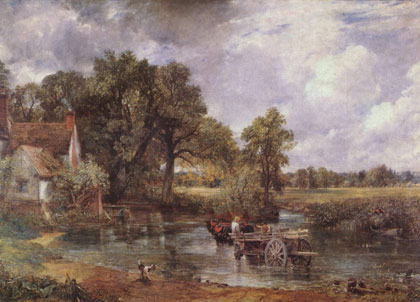
گالری علوفه، جان کنستابل
1821، گالری ملی، لندن
این تابلو به عنوان بزرگترین نقاشی بریتانیایی ارزشمند و مورد تقدیر واقع  می‌شود، اما وقتی که برای اولین بار در سال 1821 در آکادمی ‌سلطنتی نمایش داده شد (با عنوان: نیم روز)، در پیدا شدن خریدار ناکام ماند. ولی وقتی در فرانسه تئودور گریکالت این اثر را تحسین کرد بیشتر مورد توجه قرار گرفت. و بالاخره وقتی در یک سالن در پاریس همراه با تابلوهای دیگر کنستابل نمایش داده شد شور و هیجان بیشتری را برانگیخت (گفته شده که حضور داشتن نقاشی‌‌های دیگر کنستابل در این نمایشگاه یک هدیه برای گریکالت که خیلی زود و در همان سال فوت کرد، به شمار می‌آمده). در این نمایشگاه تابلوی گالری علوفه به طور قطع به عنوان برنده مدال طلایی که توسط چارلز ایکس از فرانسه اهدا می‌شد انتخاب شده بود. آثار کنستابل در این نمایشگاه تحت تاثیر و الهام گرفته از نقاش‌‌های فرانسوی مثل اوژن دلاکروا بود.
 
 
برج بابل، پیتر بروگل مهتر
1563، موزه کانستیستوریس، وین
موضوع این نقاشی سازه برج بابل است؛ در کتاب مقدس آمده که این برج ساخته دست بشر برای رسیدن به بهشت بوده. بروگل در نشان دادن معماری برج بابل با طاق‌‌ها بیشمار و نمونه‌‌های دیگر از مهندسی رومی، عمدا کلسئوم روم را تداعی کرده است. هدف او از این نقاشی این بوده که خطرات غرور بشر و شاید هم هم زیانبار بودن عقلانیت کلاسیک در مواجه با الاهیت را نشان دهد.
 
 
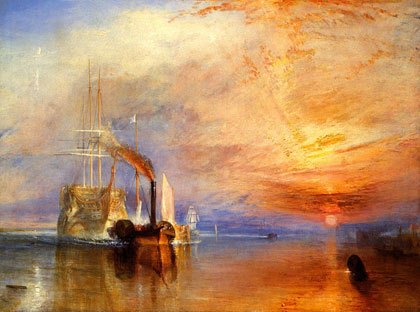
تمرر جنگجو به آخرین لنگرگاهش کشیده می‌شود تا از هم باز شود، جی.ام.دبلیو. ترنز
1838، گالری ملی، لندن
در مهم‌ترین بخش نقاشی، یعنی کشتی جنگی قدیمی، ترکیب بندی اثر غیر عادی است، که در سمت چپ تصویر جا داده شده یعنی جایی که بر شکوه و جلال اثر تاکید می‌شود و اکثر رنگهای شبح گونه آن در گوشه ای از مثلثی قرار گرفته است که در دو گوشه دیگر آن آسمان آبی و همچنین مهی که به سوی آسودگی خیال پیش می‌رود،  قرار دارد. زیبایی قایق کهنه در کنتراست قوی و رنگهای سیاه  و چرکین قایق با بخارهایی نمود پیدا می‌کند که به سرعت از روی سطح دریاچه بلند می‌شود؛ "مثل بخار آب". در سال 2005 این نقاشی به عنوان عالی‌ترین اثر هنری در گالری هنر بریتانیا انتخاب شد.
 

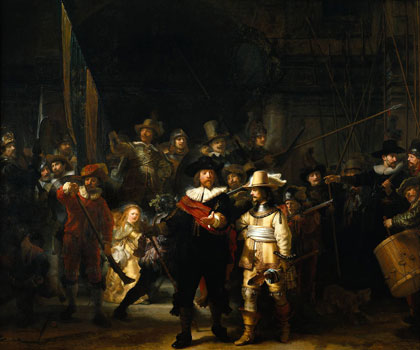
گشت شبانه، رامبرانت وان رین

1642، آمستردام، Rijksmuseum
از این نقاشی به عنوان بهترین کار رامبراند نام برده شده است، چرا که این اثر تمام الگوهای نقاشی را شکسته تا حدی که تمام نقاشان چهره آن دوران از خلق این اثر ابراز نگرانی و ناراحتی کردند. این نقاشی به تازگی به نمایش گذاشته شده و به عنوان یکی از بهترین آثار اروپای شمالی به بازدیدکنندگان ارائه می‌شود.


خوک چران، بریتانی، پل گوگن
1888، موزه هنر شهر لس آنجلس
گوگن یکی از نقاشان پیشرو پست امپرسیونیست به شمار می‌آید. این نقاشی رنگین نسبت به نقاشی‌‌های دیگر گوگن به سبک پخته خاص خودش فضاهای رئال بیشتری دارد. "خوک چران" با کشاورز و خوکهایش و پس زمینه ای از خانه‌‌های کوچک روستایی و آسمان،  از پیش زمینه ای متفاوت برخوردار است. رنگهای قوی و تکه تکه یکی از سبکهای خاص و متعلق به گوگن است.
 
 
دو خواهر (روی تراس)، پیر آگوست رنوآر
1881، موسسه هنری شیکاگو
تجلیل از زیبایی بهار و پیمانهای دوران جوانی، در تابلوی دو خواهر (روی تراس) سبک تکنیکی و کمپوزیسیون درست، نمایش هنرمندانانه رنگهای لرزان باطراوت به خوبی مشهود است. اکثر تصاویر نقاشی در اندازه واقعی قضایی سطحی را در جلوی تراس اشغال کرده اند؛ و در پشت آنها فضایی پرنشاط و پر از برگ مورد توجه قرار می‌گیرد که به نحو بسیار شدیدی روی فرمها و شکلهای نقاشی شده فوکوس می‌کند. صورت دو دختر به شدت بر اصول نقاشی جدید رنوآر تاکید داشته و آن را آشکار می‌کند و رنگ صورتها تحت تاثیر سایه‌‌ها یا بازتابها قرار نگرفته است. رنگ چشمهای دختر کوچک بسیار شفاف  و واضح، به رنگ آبی ترانسپورانت و شفاف، ما را به تماشا کردن جهان با نگاهی تازه و از دید چشمانی بی‌گناه دعوت می‌کند.
 

|
امتیاز مطلب : 0
|
تعداد امتیازدهندگان : 0
|
مجموع امتیاز : 0
تاریخ : جمعه 10 تیر 1390
نویسنده : konami

Odin DVD Ripper به شما این امکان را میدهد تا فیلم های DVD خود را به فرمت های محبوب قابل اجرا بر روی دستگاه های پخش تصویر تبدیل نمایید. به وسیله این نرم افزار نه تنها می توانید فیلم های DVD خود را بدون افت کیفیت و با سرعت فوق العاده بالا کم حجم کرده و به فرمت هایی چون H.264/MPEG-4 AVC, Apple TV h.264 1080P, HD WMV, MPEG-2/MPEG-4 TS HD Video تبدیل کنید، بلکه می توانید آن ها را به فرمت های رایج تصویری چون AVI, MPEG, WMV, DivX, MP4, H.264/MPEG-4 AVC, RM, MOV, XviD, 3GP, MP3, WMA, WAV, RA, M4A, AAC, AC3, و OGGنیز تبدیل نمایید. دیگر قابلیت جالب این نرم افزار توانایی تبدیل کردن DVDهای صوتی به فرمت های محبوبی چون  MP3, WMA, AAC, و WAVمی باشد.


 Odin DVD Ripper اجرای فیلم های DVD بروی روی انواع دستگاه ها با Odin DVD Ripper 6.5.2


password اجرای فیلم های DVD بروی روی انواع دستگاه ها با Odin DVD Ripper 6.5.2پسورد فایل: www.downloadha.com

download اجرای فیلم های DVD بروی روی انواع دستگاه ها با Odin DVD Ripper 6.5.2 لینک دانلود – 7.2 مگابایت | لینک کمکی


|
امتیاز مطلب : 0
|
تعداد امتیازدهندگان : 0
|
مجموع امتیاز : 0
تاریخ : جمعه 10 تیر 1390
نویسنده : konami

Universal Shield یک نرم افزار از شرکت Everstrike Software می باشد که با بودن تمامی برنامه های امنیتی در دنیای نرم افزارها، با وجود خود امنیت نهایی را برای سیستم شما فراهم می کند. از مهمترین قابلیت این نرم افزار می توان به پنهان کردن و رمزگذاری بر روی فایل ها، فولدرها و درایوها و همچنین قرار دادن محدودیت دسترستی به اکثر فایل های خود اشاره کرد. حتی می توانید برای ورود به نرم افزار و حذف آن از روی سیستم رمز قرار دهید تا امکان دسترسی تا حدودی به صفر برسد. دیگر قابلیت کاربردی این نرم افزار قفل کردن دسکتاپ می باشد که به وسیله این قابلیت دیگر کاربران توانایی حذف، اضافه کردن و تغییر شورتکات ها و آیکون های موجود بر روی دسکتاپ را نخواهند داشت.


 Universal Shield تامین کامل امنیت کامپیوتر با Universal Shield 4.5


password تامین کامل امنیت کامپیوتر با Universal Shield 4.5پسورد فایل: www.downloadha.com

download تامین کامل امنیت کامپیوتر با Universal Shield 4.5 لینک دانلود – 4.9 مگابایت | لینک کمکی


|
امتیاز مطلب : 0
|
تعداد امتیازدهندگان : 0
|
مجموع امتیاز : 0
تاریخ : جمعه 10 تیر 1390
نویسنده : konami

mediAvatar Audio Converter Pro یک نرم افزار حرفه ای در زمینه تبدیل و استخراج سازی فایل های صوتی و همچنین رایت و ریپ کردن CD ها می باشد. این نرم افزار به شما این امکان را میدهد تا موزیک های خود را بدون افت کیفیت به فرمت های مختلف صوتی ای چون MP3, WMA, WAV, AAC, FLAC, OGG, APE تبدیل نمایید. همچنین می توانید صدای موجود در فیلم های نسبتا با کیفیت را از آن خارج کرده و آن را به صورت یک فایل صوتی بر روی سیستم خود ذخیره نمایید و یا حتی آن را به صورت مستقیم بر روی CD رایت کرده و یک Audio CD بسازید. دیگر قابلیت کاربردی این نرم افزار توانایی آن در اضافه کردن افکت های مختلفی مانند محو کردن صدا، تنظیم اکوی آهنگ, تنظیم سرعت اجرای آهنگ و … می باشد.


mediAvatar Audio Converter تبدیل حرفه ای فایل های صوتی با mediAvatar Audio Converter Pro 6.2.0 build 0408


password تبدیل حرفه ای فایل های صوتی با mediAvatar Audio Converter Pro 6.2.0 build 0408پسورد فایل: www.downloadha.com

download تبدیل حرفه ای فایل های صوتی با mediAvatar Audio Converter Pro 6.2.0 build 0408 لینک دانلود – 26.3 مگابایت | لینک کمکی


|
امتیاز مطلب : 0
|
تعداد امتیازدهندگان : 0
|
مجموع امتیاز : 0
آخرین مطالب

/
به وبلاگ من خوش آمدید

💬 نظرات کاربران
💬ثبت نام کاربران
💬ورود کاربران